2026-06-11
Vue Reactivity: From defineProperty to Proxy
Study notes. The material comes from differences I ran into working on Vue2 / Vue3 dual-stack projects; the diagrams are my own, and every code snippet runs.
Dual-stack development comes with a particular experience: same business, same form logic, and the code that "changed but didn't render" in Vue2 suddenly works in Vue3 — this.obj.newKey = 1 leaves the page untouched in Vue2, but takes effect immediately in the Proxy version.
This isn't a magic upgrade. The reactivity system changed its implementation foundation. Once you understand that change, most of the "behavioral differences" between the two generations explain themselves. In order: how Vue2 did it, what it lacked, what Proxy added, and why Proxy must be paired with Reflect.
1. Vue2: Recursively Hijack Every Property at Initialization
Object.defineProperty can hijack the reads and writes of one existing property at a time. To make a whole object reactive, you have to recurse through it at initialization and wrap every property:
function defineReactive(obj, key, val) {
  observe(val); // recurse into nested objects
  const dep = new Dep();
  Object.defineProperty(obj, key, {
    get() {
      Dep.target && dep.depend(); // collect during render: who is reading me
      return val;
    },
    set(newVal) {
      if (newVal === val) return;
      val = newVal;
      observe(newVal);
      dep.notify(); // dispatch updates: everyone who read me runs again
    },
  });
}
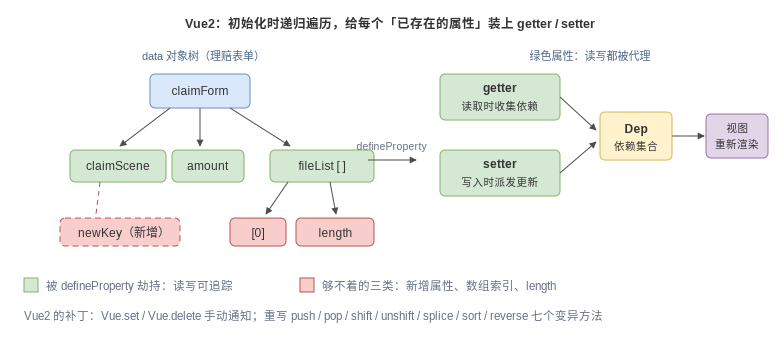
Figure 1 · At initialization, the whole data tree is traversed recursively and every existing property gets a getter / setter; the three red categories are the ones this mechanism can never reach
Collecting dependencies in the getter and dispatching updates in the setter — the idea itself is sound. The problems all come from two qualifiers: "at initialization" and "every existing property".
Adding and deleting properties goes undetected. defineProperty registers property by property name. A newly added property was never registered, has no setter, and nobody knows when it changes. delete is the same — deletion just makes the property disappear, without firing any callback. That's why Vue2 needs Vue.set / Vue.delete: in essence they bypass the object itself and patch the gap with "notify manually after the change".
Array indices and length go undetected. Assigning to list[3] or changing list.length is invisible to defineProperty. Vue2's patch is rewriting the seven mutation methods — push / pop / shift / unshift / splice / sort / reverse. Why these seven? Because they are the only methods that change the array's contents; the others (map, filter, slice) return new arrays, and reassigning the result triggers the setter. These seven methods were replaced with versions that "run the native operation first, then call dep.notify() manually".
Initialization is expensive. Whether or not a nested property will ever be used, initialization has to recurse through everything and wrap it one defineProperty at a time. Put a large object (say, an entire claim form) into data, and the first render pays a traversal tax up front.
These three defects are three projections of one root cause: the unit of hijacking is the "property", and everything outside properties — adding, deleting, indexing — is out of range.
2. Vue3: From "Hijacking Properties" to "Proxying Objects"
Proxy's unit of interception isn't the property. It's operations on the whole object:
| Operation intercepted | handler method | Corresponding syntax |
|---|---|---|
| Property read | get |
obj.prop, obj['prop'] |
| Property write | set |
obj.prop = val |
| Property deletion | deleteProperty |
delete obj.prop |
| Existence check | has |
'prop' in obj |
| Key enumeration | ownKeys |
Object.keys(obj) |
Adding a property goes through set, deleting goes through deleteProperty, and array indices and length are just ordinary get / set — Vue2's three defects are three dividends from a single replacement. Vue.set is gone, and the seven mutation methods never need rewriting again.
There's also a less visible gain: lazy proxying. Vue2 recursively hijacks the whole tree at initialization; Vue3 proxies a level only when it's accessed:
function reactive(obj) {
  return new Proxy(obj, {
    get(target, key, receiver) {
      track(target, key);
      const result = Reflect.get(target, key, receiver);
      // only accessed nested objects become reactive; untouched branches cost nothing
      if (typeof result === 'object' && result !== null) {
        return reactive(result);
      }
      return result;
    },
    set(target, key, value, receiver) {
      const old = target[key];
      const result = Reflect.set(target, key, value, receiver);
      if (old !== value) trigger(target, key);
      return result;
    },
  });
}
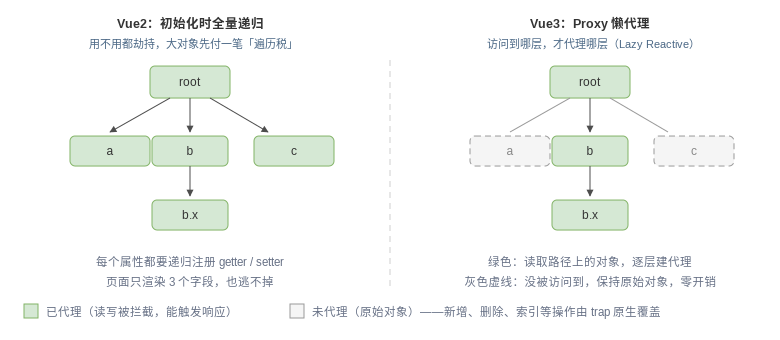
Figure 2 · Top: Vue2 recursively walks the entire tree at initialization and installs a getter / setter on every property. Bottom: Vue3 builds proxies level by level only along accessed branches; deep, unused fields stay untouched
If a large object renders only two or three of its fields, Vue2 still recurses through all of it; Vue3 touches only the paths that were read. API data on a list page is often "thirty fields, three used". The cost is invisible day to day, and very visible when first-render metrics are tight.
3. Why Reflect Is Required
The most frequently asked question about the reactive implementation: in Reflect.get(target, key, receiver), why not just write target[key]?
The critical scenario is nested getters:
const raw = {
  get fullName() {
    return `${this.first} ${this.last}`;
  },
};

const proxy = new Proxy(raw, {
  get(target, key, receiver) {
    return Reflect.get(target, key, receiver); // this points to the proxy
    // return target[key];  // this points to raw — disaster
  },
});
target[key] reads through the raw object, so this inside the getter is raw. The this.first read then doesn't pass through the proxy, track collects no dependency, and the visible symptom is "first / last changed, fullName didn't update".
Reflect.get(target, key, receiver)'s third argument sets receiver — the proxy object — as the getter's this, so this.first is routed back into the proxy's get trap and dependency collection is restored. Proxy handles the interception; Reflect's job is "forward with the original semantics, but fix this". They're partners, not duplicates.
The other reason is the return-value contract: Reflect.set returns a boolean for success or failure, which fits the Proxy handler's return requirement (the set trap is expected to return a boolean). A hand-written target[key] = value produces no such signal — when an operation fails (say, the property is read-only), you're left guessing via exceptions.
That also explains ref's .value: Proxy can only wrap objects, and primitives like number / string can't be wrapped. ref puts the value inside a { value: x } object and makes that object reactive — auto-unwrapping in templates just hides the wrapper. .value isn't an API design preference; it's the inevitable consequence of primitives having no Proxy channel.
4. Where Did Dependency Tracking Go: targetMap
In Vue2, every property carries a Dep in its closure. Vue3's Proxy traps are shared by all properties, so dependencies live in one global table instead:
const targetMap = new WeakMap(); // raw object → (key → set of effects depending on it)
let activeEffect: (() => void) | null = null;

function track(target: object, key: string | symbol) {
  if (!activeEffect) return; // not read inside an effect, nothing to record
  let depsMap = targetMap.get(target);
  if (!depsMap) targetMap.set(target, (depsMap = new Map()));
  let deps = depsMap.get(key);
  if (!deps) depsMap.set(key, (deps = new Set()));
  deps.add(activeEffect);
}

function trigger(target: object, key: string | symbol) {
  const depsMap = targetMap.get(target);
  depsMap?.get(key)?.forEach((effect) => effect());
}
Each of the three layers handles one thing: the WeakMap splits by object (weak keys, so when an object is destroyed its dependencies are collected with it — no manual cleanup); the Map splits by property; the Set deduplicates — the same effect reading the same property ten times is recorded once.
The Set dedup also explains a famous Vue3 behavior: change the same ref three times in a row inside a component, and the view updates once — three trigger calls push the same effect into the same Set, and after batching it runs a single time.
5. Putting It Together
| Vue2 (defineProperty) | Vue3 (Proxy) | |
|---|---|---|
| Unit of interception | A single existing property | Operations on the whole object |
| Add / delete properties | Undetected; needs Vue.set / Vue.delete |
Supported natively |
| Array index / length | Undetected; needs 7 rewritten mutation methods | Supported natively |
| Initialization | Full recursive hijacking | Lazy proxying, converted on access |
| Where dependencies live | A Dep in each property's closure | Global targetMap (WeakMap) |
| Map / Set | Not supported | Supported with dedicated handling |
For everyday coding, the things actually worth remembering:
Destructuring breaks the connection. const { name } = reactive(obj) gives you the raw value, disconnected from the proxy — change obj.name afterward and name won't update. Use toRefs if you need to destructure. This isn't a Proxy bug; it's the inherent conflict between "copy the value" and "track the reference".
Replacing the whole object needs care. state = { ...newData } changes where the variable points, not the properties inside the proxy — nothing listens. Assign field by field when that's what you mean.
The list of Vue2's seven mutation methods is worth memorizing. Judging whether "this operation is detectable in an old codebase" comes down to knowing which methods were rewritten: the ones that mutate array contents were; the ones returning new arrays require reassignment.
One closing thought: Vue3 switching to Proxy isn't "new tech replacing old tech". It's the abstraction level of interception moving up one layer — from "property reads and writes" up to "operations on objects". Vue.set and the rewritten array methods were patches applied at the old level; once the level changed, every patch lost its reason to exist. A lot of "framework behavior differences" have their roots at exactly this kind of abstraction level.